
Your kitchen sink is draining slowly. You call a plumber, they snake the drain, charge you a fee, and leave. Problem solved — right?
Maybe. Or maybe you just paid to temporarily clear a symptom while the real problem continues to get worse underground.
This is one of the most common and costly misunderstandings in home plumbing maintenance. Drain cleaning and sewer repair are not the same thing. They solve different problems, use different tools, and produce very different long-term outcomes. Knowing the difference could save you from repeating the same service call every few months — and from a much bigger surprise down the road.
What Is Drain Cleaning?
Drain cleaning is exactly what it sounds like: physically clearing a blockage from inside a pipe so water can flow through again.
The most common method is drain snaking (also called augering) — a long, flexible cable with a cutting head is fed into the drain and rotated to break up or pull out whatever is causing the clog. Another common method is hydro-jetting, which uses high-pressure water to blast away grease, scale, and debris from the pipe walls.
Drain cleaning is fast, relatively straightforward, and effective at restoring flow. It is the right solution when the problem is a blockage — accumulated grease, hair, soap scum, food debris, or a foreign object caught in the line.
What drain cleaning does not do is fix the pipe itself. If the pipe is cracked, has shifted, has root intrusion cutting through the walls, or has sections that have collapsed or bellied, clearing the blockage gives you temporary relief at best. The underlying structural problem remains — and it will keep causing issues.
What Is Sewer Repair?
Sewer repair addresses damage to the pipe itself — not just what's inside it.
Common reasons a sewer line needs repair include:
- Root intrusion — tree and shrub roots seek out moisture and can infiltrate pipe joints and cracks, eventually causing significant blockages and structural damage
- Pipe corrosion — older cast iron and clay pipes corrode, crack, and deteriorate over time
- Joint separation — soil movement, settling, or seismic activity can cause pipe sections to separate at the joints
- Pipe bellying — sections of pipe sag downward due to soil shifting, creating a low point where waste accumulates
- Collapsed pipe — severe deterioration or external pressure causes the pipe to cave in entirely
These are not clogs. Snaking a line with root intrusion might temporarily restore flow, but the roots will grow back — often faster than before, because the disturbance stimulates regrowth. Snaking a bellied pipe does nothing to address the sag. These problems require repair or replacement of the pipe itself.
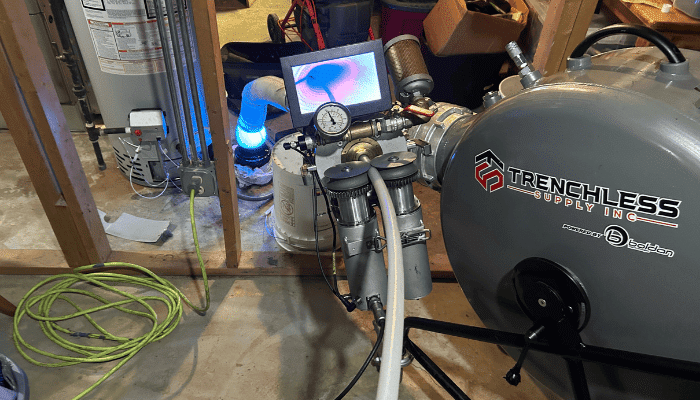
Modern sewer repair doesn't necessarily mean tearing up your yard. Trenchless methods like cured-in-place pipe lining (CIPP) and pipe bursting allow contractors to rehabilitate or replace a damaged sewer line from the inside — with minimal digging, minimal disruption, and a long-lasting result.
How Do You Know Which One You Actually Need?
This is the critical question — and the honest answer is that you can't know for certain without a sewer camera inspection.
A camera inspection involves feeding a waterproof, high-definition camera through your sewer line so a technician can see exactly what's happening inside. It's the only way to definitively distinguish between a blockage (a drain-cleaning problem) and structural damage (a sewer-repair problem).
Here's a simple way to think about it:
Drain cleaning is likely sufficient when:
- The problem is isolated to one fixture
- Clogs are infrequent, and you can identify a cause (grease buildup, hair, etc)
- The home is relatively new, and the pipes are in good condition
- A camera inspection confirms no structural damage
Sewer repair is likely needed when:
- Multiple fixtures are affected at the same time
- Clogs keep coming back within weeks or months of being cleared
- You notice sewage odors, soft spots in the yard, or unusually lush grass over the sewer line
- The home is older (20+ years) with original clay or cast iron pipes
- A camera inspection reveals cracks, root intrusion, bellying, or joint separation
The Problem With Repeated Drain Cleaning
One pattern we see frequently is homeowners who have had their drains snaked multiple times over a year or two — each visit providing a few weeks or months of relief before the slow drains or backups return.
This cycle feels like maintenance. It isn't. It's a sign that something structural is going on, and each visit that clears the symptom without diagnosing the cause is a missed opportunity to solve the actual problem.
Repeated drain cleaning on a structurally compromised line can also make things worse. Aggressive snaking can further damage already-weakened pipe walls. And every month that root intrusion or a crack goes unaddressed is another month of deterioration.
If you've had your drains cleaned more than twice in the past 12 months and the problem keeps returning, it's time to get a camera inspection — not another snake.
The Bottom Line
Drain cleaning has its place — it's a legitimate, useful service for genuine blockages. But it's a maintenance tool, not a repair solution. When the pipe itself is the problem, no amount of snaking will give you a lasting fix.
If your drains are slow, your backups keep returning, or you just haven't had your sewer line looked at in years, the smartest first step is a camera inspection. It takes the guesswork out of the equation entirely and tells you exactly what you're dealing with — so you're not spending money on the wrong solution.
Trenchless Innovations provides professional sewer camera inspections, drain cleaning, and full trenchless sewer repair services throughout the Chicagoland area. If you're not sure what's going on with your sewer line, we'll help you find out. Give us a call at 708-758-5070 or schedule your inspection online.