
Can trenchless sewer repair be done in winter?
Yes. Trenchless sewer repair methods like cured-in-place pipe (CIPP) lining can be performed year-round in the Chicago area, including in winter. Because trenchless repairs require only small access points instead of full excavation, frozen ground is far less of an obstacle than it is for traditional dig-and-replace repairs. Waiting until spring often means living with a worsening problem — and paying more once the damage spreads.
Why homeowners assume winter isn't an option
The assumption is a leftover from how sewer work used to be done. Traditional sewer repair meant excavating a long trench across your yard, breaking through frozen topsoil, working around frost lines that in the Chicago area routinely reach 40 inches or deeper, and hoping the weather cooperated for days at a time. Understandably, most contractors pushed those jobs into spring.
Trenchless sewer repair works differently — and that changes what's possible in cold weather.
Learn more about how modern methods compare in How to Choose the Right Sewer Line Repair Method for Your Home.
How trenchless repair handles winter conditions
Instead of digging up your yard, trenchless repair uses small access points — often an existing cleanout or a single compact excavation — to reach the damaged line. The bulk of the work happens inside the existing pipe.
For cured-in-place pipe (CIPP) lining, a resin-saturated liner is pulled or inverted into the host pipe and then cured in place, forming a new pipe within the old one. The curing process is temperature-controlled and happens inside the pipe itself, not exposed to the outside air. That means winter temperatures don't compromise the finished product.
Frozen ground actually works in favor of trenchless methods in one specific way: less mud. Access points stay cleaner, and the small footprint of the work means minimal disruption to frozen or snow-covered landscaping.
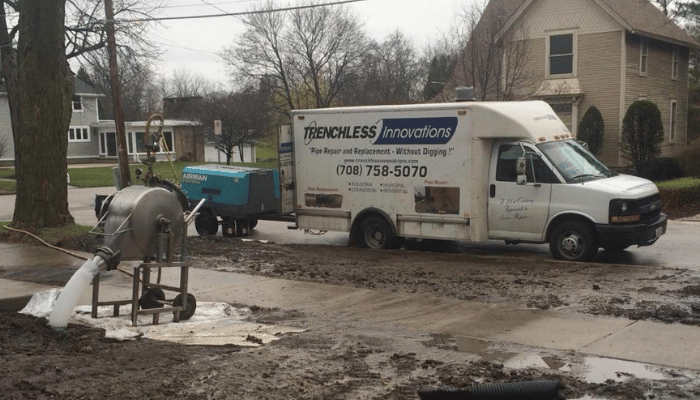
See a real cold-weather job in Sewer Lining on a Cold Chicago Day.
Why waiting until spring can cost you more
Here's the part most homeowners don't hear: winter is often when sewer problems get worse, not when they stay the same.
- Freeze-thaw cycles move the ground. Every time Chicago-area soil freezes and thaws, it shifts. That movement puts stress on already-compromised pipes, widening cracks and pushing joint separations further apart.
- Tree roots keep growing. Dormant doesn't mean dead. Root intrusion continues underground through winter, and by spring the blockage you had in November is a bigger blockage.
- A small leak becomes a bigger repair. Water escaping from a cracked line during winter can undermine soil around the pipe, creating voids that lead to bigger structural issues — and a bigger bill — later.
More on that in Is Your Sewer Causing Sinkholes? and Tree Root Intrusion in Sewers.
What winter trenchless work actually looks like
For most residential jobs, here's what to expect:
- A camera inspection confirms the location and condition of the damage.
- Our team identifies an access point — often an existing cleanout, sometimes one small dig.
- The line is cleaned and prepared.
- The trenchless repair — most often CIPP lining — is installed and cured.
- A final camera inspection verifies the new pipe.
Most residential sewer lining jobs are completed in a single day. Your yard doesn't get torn up. Your driveway stays intact. And you're not living with the problem for another four months.
When winter repair makes the most sense
- You're actively experiencing backups or slow drains.
- A recent camera inspection flagged cracks, offsets, or root intrusion.
- You're buying or selling a home this winter and the inspection uncovered a sewer issue.
- You have a commercial property, condo building, or HOA where downtime needs to happen during a quieter season.
For HOA and condo boards specifically, we cover this in Sewer Repair for Condo Boards and HOAs: What to Know Before You Sign.
Not sure if your problem needs to be fixed now?
If you've had another company tell you a sewer repair has to wait until spring — or that the only option is a full excavation — it's worth a second opinion. We look at the actual pipe condition and the actual site, not the calendar.
In most cases, no. The method and the materials are the same year-round. Because the work doesn't require large-scale excavation, winter conditions don't add the labor and equipment costs they add to traditional dig-and-replace repairs.
Yes. Trenchless liners are installed and cured inside the existing pipe, so frozen surface soil doesn't affect the process. Access points are small enough that frost isn't a barrier the way it is for full trench excavation.
For active backups, we prioritize scheduling. Contact us and we'll walk through the situation and next steps.