
How Should Chicago Homeowners Prepare Their Ductwork for Winter?
Quick answer: Fall is the ideal time to prepare your air ducts for Chicago winter. A proper duct prep checklist includes:
- Inspect visible above-ground ductwork for damaged insulation, disconnected joints, and rust.
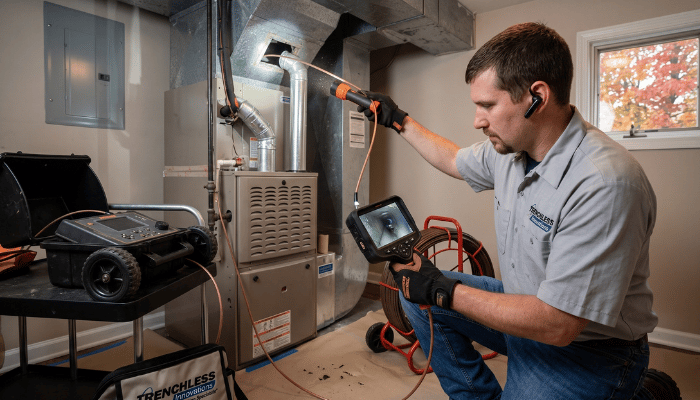
- Schedule a professional camera inspection of underground ductwork, especially in homes built before 1980.
- Check for water intrusion in in-slab and basement ducts before freezing temperatures arrive.
- Test airflow at every register to identify weak or blocked runs before you rely on your heating system.
- Address any duct leaks, cracks, or deteriorating sections with trenchless duct lining before winter demand strains your system.
Getting ahead of duct issues in fall prevents higher heating bills, uneven room temperatures, and mid-winter emergency repairs when your HVAC system is working hardest.
Why Fall Is the Most Important Season for Chicago Duct Maintenance
In the Chicago metro and Northwest Indiana, your air ducts do their hardest work in the coldest months of the year. From late November through March, your furnace can run for 10+ hours a day, pushing heated air through every duct run in your home. If your ductwork isn't in good shape, winter is when you'll feel it — in your comfort, in your energy bills, and sometimes in emergency repair calls when it's 15 degrees outside.
Fall is the right time to get ahead of all of that. Between September and early November, temperatures are still mild, your HVAC system isn't yet under full load, and there's time to schedule an inspection or repair without disrupting your heating. Homeowners who wait until December often find themselves paying more for less-flexible service windows — or worse, dealing with duct failures during the coldest weeks of the year.
Here's a complete fall duct prep checklist for Chicagoland homes, covering both above-ground and underground ductwork.
Above-Ground Ductwork Fall Prep
Above-ground ducts — the metal or flexible runs you can see in your attic, basement, crawl space, or utility closet — are the more accessible part of your HVAC system. Most homeowners can do a basic visual check themselves before scheduling a professional inspection.
What to look for:
- Sagging or crushed sections of flexible ductwork
- Visible rust or corrosion on metal ducts, especially near joints
- Damaged or missing insulation on ducts running through unheated spaces (attics, crawl spaces, garages)
- Loose or disconnected joints where two duct sections meet
- Water stains or moisture on ducts, insulation, or the surfaces below them
- Excessive dust buildup around register vents
- Any tape holding ducts together — old duct tape (yes, really — most duct tape is not rated for HVAC use) breaks down over time and leads to leaky joints
If you notice any of these signs, they warrant a professional inspection before you rely on your heating system all winter. Even small leaks in above-ground ducts can cost you 20–30% of your heating efficiency, according to Energy Star estimates.
For a full breakdown of what a professional above-ground assessment covers, see our above-ground air duct inspection page.
Common above-ground duct issues we see in Chicago-area homes each fall:
- Insulation deterioration on ducts in attics (often the first thing to fail after 15–20 years)
- Rusted joints on galvanized steel ducts in basements with historical moisture issues
- Rodent damage on flexible ducts in crawl spaces (mice and squirrels chew through flex duct easily)
- Improperly sealed transitions where old and newer duct sections were joined during past HVAC work
If your home is more than 20 years old and hasn't had a professional duct inspection in the last 5 years, fall is the time to schedule one. Our above-ground air duct services page walks through what happens when we identify issues that need repair.
Underground Ductwork Fall Prep
Underground ductwork — ducts that run through, under, or embedded in your concrete slab — is a much bigger deal in Chicago-area homes than most people realize. Homes built on slab foundations from the 1940s through the 1980s, especially ranch-style homes and mid-century construction, frequently have in-slab underground duct systems. And those systems age in ways that are invisible from above the floor.
Underground ductwork faces problems that above-ground systems never deal with:
- Groundwater intrusion, especially after wet fall weather
- Soil pressure that can shift, sag, or crack duct materials over time
- Freeze-thaw cycles that accelerate deterioration of concrete and cardboard duct materials
- Asbestos degradation in older transite (asbestos cement) duct systems
- Rust and corrosion in galvanized steel ducts sitting in wet soil
None of these problems are visible without a professional camera inspection — and by the time you can feel the symptoms (weak airflow, cold rooms, musty smells, rising heating bills), the underlying damage is often significant.
Signs your underground ducts need fall attention:
- Cold rooms that don't warm up even when the heat has been running
- Uneven temperatures between rooms with the same thermostat setting
- Musty, earthy, or moldy smells when the heat kicks on
- Rising heating bills without any change in usage
- Debris (sand, small stones, or particulate) blowing out of your registers
- Water accumulation near register openings after heavy rain
Not sure what type of underground ductwork your home has? Our complete guide to the types of underground ductwork breaks down each material — transite, galvanized steel, PVC, concrete Sonotube, and cardboard Sonotube — and explains which ones fail most often.
For a full inspection of your underground system, our underground air duct inspection services use specialized cameras to assess the material, condition, and problem areas in your ducts without any excavation.
Not sure where to start? Get a free second opinion before winter.
Already had a duct estimate from another contractor? Our team offers a free second opinion on any duct inspection or repair recommendation you've received. No pressure, no upsell — just an honest assessment before you commit to major work heading into heating season.
What Happens If We Find a Problem in Fall Inspection?
The good news: most duct problems we find in fall inspections can be fixed before winter, without excavation, and without waiting weeks for a repair window.
For above-ground ductwork, repair usually involves sealing leaky joints, replacing damaged insulation, or installing new sections where flexible ducts have been crushed or damaged. For more severe deterioration, our above-ground duct lining solutions can restore aging metal ductwork from the inside — no full replacement required.
For underground ductwork, we typically recommend trenchless duct lining, which rebuilds the interior of your ducts using a seamless liner or spray-applied coating. Our underground duct lining solutions restore airflow, seal out groundwater, and encapsulate deteriorating material (including transite) without disturbing your slab or yard.
Both processes typically take 1–2 days from start to finish. In most cases, your heating system is fully operational the same day the work is completed.
If you want to understand how the lining process actually works, our breakdown of the science behind pipe and air duct lining walks through the physics and materials in more detail.
Fall Duct Prep Timeline: When to Do What
For most Chicago-area homeowners, this is the ideal sequence:
September: Do your DIY visual check of above-ground ductwork. Note any issues.
Early October: Schedule your professional inspection while service windows are still flexible. If you have underground ductwork or your home is more than 20 years old, prioritize this earlier.
Mid-October to early November: Complete any recommended repairs or lining work. Temperatures are still mild enough that a brief HVAC downtime isn't disruptive.
Late November onward: Your ductwork is winter-ready. You're not scrambling for an emergency repair in January.
Waiting until December or January to address a duct problem is one of the most common mistakes we see. Service demand is higher, temperatures are more disruptive, and homeowners often end up paying more for less-flexible scheduling. Fall is the low-stress window.
What About Duct Cleaning? Is That Part of Fall Prep?
Duct cleaning and duct inspection are different services that solve different problems. If your ducts are structurally sound but visibly dusty, cleaning may improve indoor air quality. If your ducts are experiencing airflow, leak, or moisture issues, cleaning won't fix any of that — you need an inspection to diagnose what's actually going on. For homes with underground ductwork, cleaning is often not even the right service because the underlying problems are structural, not sanitary.
Our team focuses on the diagnostic and repair side. If a professional cleaning is what your system actually needs, we'll tell you — and if there's something more serious going on, we'll show you exactly what we found.
Have specific questions about how duct lining works after an inspection reveals damage? Our duct lining FAQ page covers the most common questions homeowners ask.
Get Your Ducts Winter-Ready Before the Chicago Cold Sets In.
Fall service windows fill up quickly across our Chicagoland and Northwest Indiana service area. Whether you have above-ground ducts that need a checkup or underground ductwork that hasn't been inspected in years, our team can assess your system and recommend the right next step — with no pressure and no upsell.
Call 708-758-5070 or request service online to schedule your fall duct inspection today.