
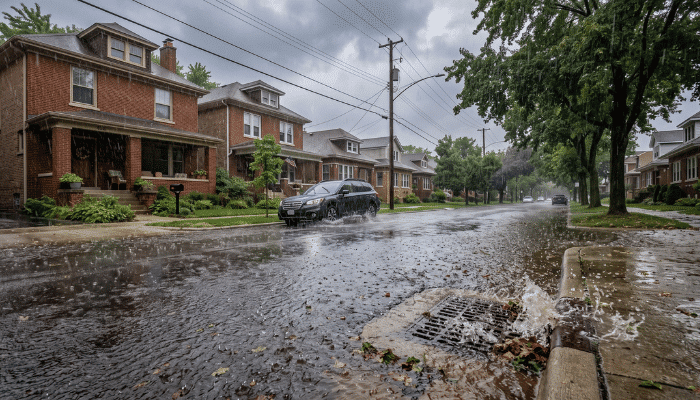
Chicago summers deliver two things reliably: humidity and hard rain. And every time a big storm dumps a couple of inches on the metro in a short window, we hear from homeowners across Chicagoland and Northwest Indiana with the same story — the basement floor drain gurgled, the toilet burped, and then the sewage came up.
It’s not random, and it’s not always the storm itself. Here’s what’s actually happening under your yard during heavy rain, and what you can do to keep it from happening again.
Why Chicago sewers back up during heavy summer rain
A few things work against you when a big storm hits, and they usually work together:
Combined sewer systems get overwhelmed
Much of Chicago and its older suburbs still run combined sewer systems — storm runoff and household wastewater share the same pipe. During heavy rain, the city main can surcharge, meaning wastewater in the main has nowhere to go except back up the lateral toward your home.
Older pipes can’t absorb the surge
A lot of Chicagoland homes were built with clay tile or cast iron sewer lines. Clay develops offsets and cracks over decades. Cast iron scales and thins from the inside out. When the flow doubles or triples during a storm, existing weak spots start leaking, catching debris, or collapsing — and a line that seemed fine in dry weather can’t keep up.
Tree roots do their fastest growing in summer
Roots grow most aggressively in late spring and summer, and they follow the water. Any hairline crack or loose joint in your sewer line becomes a gateway. A pipe that carried water fine in April can be half-blocked by roots by July.
Small clogs turn into big backups fast
Grease, wipes, and buildup that felt “manageable” in dry weather stop being manageable when the pipe is also handling storm surge. The extra volume is what tips a slow drain into a full basement backup.
Signs your sewer line is at risk
You usually get warnings before a full backup — most people just don’t recognize them. Watch for:
- Slow drains that have gotten slower over the last few months
- Gurgling from toilets or floor drains when other fixtures run
- Sewer odor near a floor drain, cleanout, or out in the yard
- Patches of unusually green or soggy grass along the sewer line’s path
- Small backups after rainstorms that clear on their own — this one especially
If any of those sound familiar, your line is telling you it’s already compromised. The next big storm is when it’ll show you.
What to do before the next storm
Four things are worth doing now, before the next front moves through:
1. Get a sewer camera inspection
A video inspection is the only way to know what’s actually happening inside your line. We run a camera from your cleanout to the city main and show you exactly what we see — cracks, roots, offsets, scale, standing water. It takes an hour or two and gives you a real answer instead of a guess. No dig, no assumptions.
2. Ask about a backwater valve
If your line is in decent shape but you’re in a low-lying area or on a street that surcharges often, a backwater valve installed on your lateral prevents sewage from the city main from flowing back into your home. It’s a mechanical one-way door — inexpensive insurance for anyone who’s had a storm-related backup before.
3. Address damage you already have
If the camera shows cracks, root intrusion, or offset joints, the fix doesn’t have to mean digging up your yard. Cured-in-place pipe (CIPP) lining installs a new pipe inside the existing one, and it’s usually done in a day. That new liner is seamless — roots have nothing to grow into, and storm flow has somewhere to go.
4. Stop feeding the problem
Wipes, grease, and paper towels don’t break down the way toilet paper does. In a healthy line, they slow things down. In a compromised line, they’re what turns a rainy Tuesday into a basement cleanup on Wednesday.
When to call us
If you’ve had a backup already this year, if the last storm made you nervous, or if you’ve been putting off dealing with a slow drain since spring — that’s the call. We’ll come out, run the camera, show you what’s there, and give you honest options. If your line is fine, we’ll tell you it’s fine. If it’s not, we’ll walk you through what a trenchless repair would actually look like on your property. No upsell, no surprises.
Call us at 708-758-5070 or contact us online. The best time to fix a sewer line is when it’s not currently backing up.