
You've just been told your sewer line needs attention. Maybe it was a slow drain that finally got investigated with a camera, or roots showed up on an inspection, or you've had recurring backups that won't quit. Whatever the trigger, you're now facing a decision most homeowners aren't prepared for: what kind of repair do you actually need?
The answer isn't one-size-fits-all — and a good contractor should be walking you through options, not just handing you a single quote. Here's how to think through the decision.
Start with the diagnosis, not the method
Before any repair method makes sense, you need to know exactly what's wrong. A sewer camera inspection is the only reliable way to see what's happening inside your pipe — cracks, root intrusion, bellying, corrosion, or full collapse all look different and respond to different fixes. If a contractor is quoting you a repair without having run a camera, that's a red flag.
Spot repair vs. full-line solution
If the damage is isolated — a single crack, a small root intrusion, one section of pipe — a spot repair may be all you need. This targets the specific problem area without touching the rest of the line. It's faster and less expensive than a full-line solution, and in many cases it's exactly the right call.
If the damage is widespread — multiple problem areas, significant corrosion throughout, or a pipe that's simply aging out — a full-line solution makes more sense economically. Doing repeated spot repairs on a deteriorating line is like patching tires on a car that needs new wheels.
Trenchless vs. traditional excavation
For most homeowners, the biggest question is whether the repair requires digging. Traditional excavation means opening up your yard, driveway, or landscaping to access the pipe directly. It's effective but disruptive and often expensive when you factor in restoration costs.
Trenchless methods — including pipe lining and pipe bursting — address the same problems from the inside, with access points at each end of the line. No trench, minimal disruption, and in most cases a faster turnaround. Not every situation qualifies for trenchless (severely collapsed pipes or certain pipe materials can be limiting factors), but the majority of residential sewer line issues in the Chicago area are good candidates.
Lining vs. bursting — what's the difference?
These are the two primary trenchless repair methods, and they work very differently.
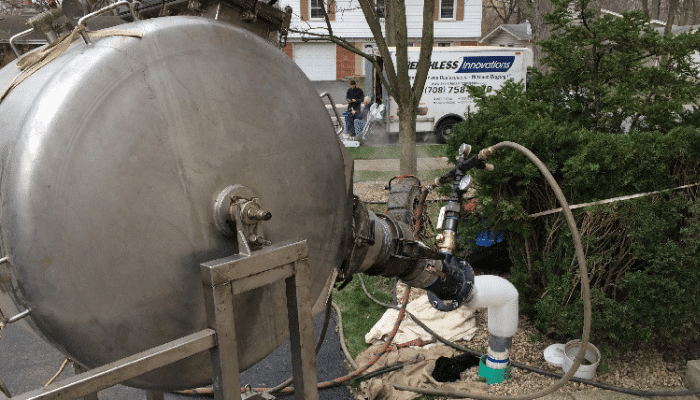
Pipe lining — specifically cured-in-place pipe (CIPP) lining — installs a resin-saturated liner inside the existing pipe. Once cured, it creates a new pipe within the old one. It's ideal for cracked, corroded, or root-invaded pipes that are still largely intact in terms of shape and position.
Pipe bursting replaces the old pipe entirely by pulling a new one through while simultaneously fracturing the old pipe outward. It's the better choice when the existing pipe is too deteriorated to support a liner, or when you want to upsize the pipe diameter.
Questions to ask any contractor before you commit
- Have you run a camera and can I see the footage?
- Is my pipe a good candidate for trenchless, and why or why not?
- Are you recommending spot repair or full-line, and what's the reasoning?
- What's the warranty on the repair method you're recommending?
- What does restoration look like after the job — what gets put back, and who handles it?
A contractor who can answer all of those clearly and without hesitation is one worth trusting. One who pushes you toward a single solution without explaining the alternatives is worth getting a second opinion on.
Ready for a Straight Answer on Your Sewer Line?
Most homeowners just want to know what's wrong, what it costs, and what the least disruptive fix looks like. That's exactly how we approach every job. We'll run the camera, show you the footage, walk you through your options honestly, and let you decide — no pressure, no upselling, no surprises.
If you're in the Chicago area and dealing with a slow drain, recurring backup, or just want to know what's going on underground before it becomes an emergency, give us a call or request service online. We're here when you need us 708-758-5070