
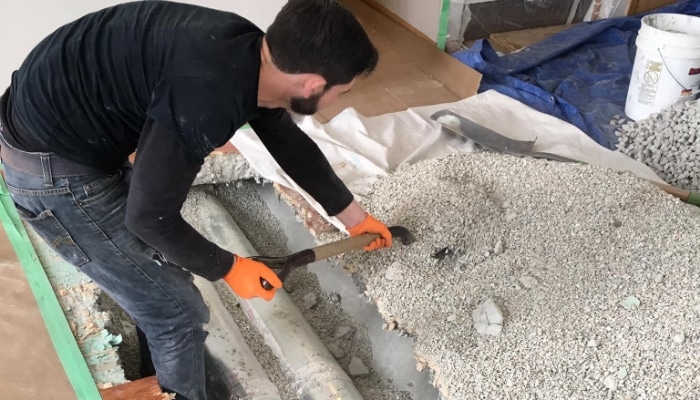
Types of Underground Ductwork: What Every Homeowner in Chicagoland Should Know
Underground ductwork is one of the most overlooked parts of a home's HVAC system — and one of the most expensive to ignore. Buried beneath your slab or crawl space, these ducts move conditioned air from your furnace or AC to every room in the house. When they fail, homeowners often see the symptoms (uneven temperatures, high energy bills, musty smells) long before they see the cause.
If you live in a home built between the 1950s and 1980s anywhere in the Chicago metro or Northwest Indiana — including neighborhoods across Chicago, Evanston, Oak Park, Schaumburg, Arlington Heights, and the south suburbs — there's a good chance your home has underground ductwork made from one of five distinct materials. Each type ages differently, and each has different repair options.
Here's what you need to know about each one, and what to do if yours is showing signs of failure.
What are the main types of underground ductwork?
The five most common types of underground ductwork found in residential and commercial buildings are:
Damaged underground ducts can typically be repaired using trenchless duct lining — a non-invasive process that restores airflow and structural integrity without excavating your slab or yard.
What Is Underground Ductwork?
Underground ductwork refers to any air duct system that runs beneath the floor — typically through, under, or embedded in a concrete slab. It's most common in ranch-style and mid-century homes built on slab foundations, and in commercial buildings with in-slab HVAC distribution.
Because these ducts sit in direct contact with soil and groundwater, they face pressures that above-ground ductwork never has to deal with: moisture absorption, corrosion, ground shifting, and — in older systems — asbestos degradation. That's why identifying the material your ducts are made from is the first step in figuring out whether you need cleaning, repair, or full trenchless duct replacement.
The 5 Most Common Types of Underground Ductwork
1. Transite (Asbestos Cement) Ductwork
Common in: Homes built between the 1930s and late 1970s
Typical condition today: Deteriorating — often significantly
Transite ductwork is manufactured from a mixture of asbestos fibers and Portland cement. When intact and dry, it's actually one of the more durable underground duct materials. The problem is that transite absorbs moisture over decades of contact with soil and groundwater, which slowly weakens the cement binder holding the asbestos fibers in place.
As transite ducts degrade, three things happen: the walls become porous, the interior surface begins to shed particulates into the air stream, and — most concerning — disturbed asbestos fibers can be pulled into the HVAC system and circulated through the home.
Because of the asbestos content, transite ductwork should never be cut, drilled, or removed by a homeowner. Any repair or replacement work has to be handled by qualified specialists using containment procedures.
Good news: Transite ductwork is one of the ideal candidates for trenchless duct lining. The lining process encapsulates the existing ductwork from the inside — sealing the asbestos in place while restoring a smooth, airtight interior surface.
2. Galvanized Steel Ductwork
Common in: Homes and commercial buildings built from the 1950s through the 1980s
Typical condition today: Moderate to severe rust and pitting
Galvanized steel was the workhorse material for underground HVAC installations for decades. It's strong, holds its shape well, and forms tight seals at joints when new. The zinc galvanization is designed to protect against corrosion — but underground, the zinc layer eventually wears through, and once bare steel is exposed to groundwater, rust develops quickly.
Common signs of failing galvanized underground ducts include:
- Whistling or rushing air sounds around registers
- Rusty water stains near duct openings
- Reduced airflow, especially in rooms farther from the furnace
- Higher-than-expected energy bills
- Uneven room temperatures
Once corrosion begins, it accelerates. Small pinholes turn into large rust perforations, and eventually the duct wall can collapse under soil pressure or fill with groundwater. Trenchless duct lining can restore galvanized steel ducts by installing a seamless internal liner that seals the leaks and prevents further corrosion — no excavation required.
3. PVC (Plastic) Ductwork
Common in: Homes built from the 1970s to the early 2000s
Typical condition today: Structurally intact but often shifted or joint-compromised
PVC underground ducting was introduced as a corrosion-resistant alternative to galvanized steel. It doesn't rust, it's relatively easy to install, and it's lightweight. But PVC has its own set of problems underground: it's less rigid than metal, so it can flex, sag, or shift out of alignment as soil settles around it. Joints and connections are the weak points — glued seams can fail, and separated joints allow soil, water, and pests to enter the duct system.
If your home has PVC underground ductwork, the biggest red flags are:
- Debris (soil, small stones, or organic matter) at register openings
- Water accumulation in the ducts after heavy rain
- Sections of the duct system that whistle or rumble under airflow
- Musty or earthy smells coming through the vents
A professional camera inspection is the fastest way to identify whether PVC ducts have shifted or separated, and duct lining can restore continuity across compromised joints.
4. Concrete Sonotube Ductwork
Common in: Slab-on-grade homes built between the 1950s and 1970s
Typical condition today: Porous, moisture-saturated, often crumbling
Concrete Sonotube ducts were formed by pouring concrete into a cylindrical mold before the slab was poured on top. On paper, concrete sounds like a permanent solution — but underground concrete is highly porous. Over years and decades, groundwater seeps in, and freeze-thaw cycles (a big factor in the Chicago climate) accelerate the breakdown.
Common problems with aging concrete Sonotube ductwork:
- Water infiltration, especially in spring or after storms
- Interior surface erosion, causing debris to blow through the system
- Mold and mildew growth inside the duct walls
- Reduced duct diameter as the walls crumble inward
- Complete collapse in severe cases
If your home has concrete Sonotube ductwork and you're seeing standing water at your registers or a persistent musty smell, the ducts are almost certainly saturated. Trenchless duct lining creates a waterproof, airtight interior surface that stops moisture intrusion and restores full airflow.
5. Cardboard Sonotube Ductwork
Common in: Post-war tract homes (late 1940s–1960s)
Typical condition today: Almost always failing
Yes — cardboard. Post-war construction shortcuts led to underground ducts being formed from waxed or resin-coated cardboard tubing, sometimes reinforced with light wire. It was cheap, fast, and technically functional when new. Today, cardboard Sonotube ductwork is the single most failure-prone type of underground ductwork.
Cardboard absorbs water on contact, and once wet:
- It swells, warps, and loses structural shape
- Mold, mildew, and bacteria colonize the interior
- The wax coating breaks down and flakes into the airstream
- Sections collapse entirely, blocking airflow
- Airborne contaminants circulate throughout the home
If your home is old enough to have cardboard Sonotube ductwork, you likely already know something is wrong — the symptoms are hard to miss. The good news is that these ducts can typically be rebuilt from the inside using underground duct lining rather than excavated and replaced.
How Do I Know What Kind of Underground Ductwork I Have?
Most homeowners have no idea what material their underground ducts are made from — and there's no reliable way to tell from outside the system. The only accurate way to identify the material and condition of your ductwork is a professional underground air duct inspection, which uses specialized cameras to visually assess the interior of your ducts from register to register.
An inspection will tell you:
- What material your ducts are made from
- Whether there is water intrusion, debris buildup, or biological growth
- The location and severity of any breaks, cracks, or collapses
- Whether your system is a candidate for trenchless lining or requires excavation
Concerned about your underground ductwork? Get a free second opinion.
Not every home needs full duct replacement. Before you sign a costly excavation contract, let our team take a look. We offer a Free Second Opinion on any underground duct diagnosis you've received from another contractor — no pressure, no upsell, just an honest assessment.
Warning Signs Your Underground Ductwork Needs Attention
Regardless of what material your ducts are made from, watch for these common warning signs:
- Uneven room temperatures — one room is always hot or cold, no matter how you set the thermostat
- Higher energy bills — your HVAC system is working harder to move air through compromised ducts
- Musty or earthy smells at the registers — a sign of water intrusion or biological growth
- Debris blowing out of vents — soil, particulate, or duct material coming through registers
- Whistling or rumbling sounds — indicates air leaks or partial collapses
- Increased indoor dust — compromised ducts pull unfiltered air into your HVAC system
- Allergy or respiratory symptoms that worsen indoors — poor indoor air quality caused by contaminated ductwork
If any of these sound familiar, a professional inspection is the fastest way to find out what's happening and what your options are.
How Trenchless Innovations Repairs Underground Ductwork
At Trenchless Innovations, we specialize in restoring underground ductwork without tearing up your yard, driveway, or concrete slab. Our process involves three steps:
- Comprehensive video inspection — We start with a full underground duct camera inspection to identify the material, condition, and specific problem areas in your system.
- Customized lining plan — Based on what we find, we develop a duct-by-duct restoration plan using our underground duct lining solutions — including trenchless casting where appropriate.
- Long-lasting restoration — Our lining process creates a smooth, seamless, airtight interior surface that seals leaks, encapsulates deteriorating material (including transite), and restores full airflow.
For homeowners and property managers across Chicagoland who don't want to face the cost, mess, and disruption of duct excavation, trenchless lining is often the smarter path. Learn more about our full underground ducting services.
The lifespan of underground ductwork depends heavily on the material. Galvanized steel typically lasts 30–50 years before corrosion becomes a serious issue. Concrete Sonotube ducts can last 40–60 years but often degrade sooner in wet climates. Transite ducts frequently exceed 60 years structurally but become health hazards long before they fail structurally. Cardboard Sonotube ducts often show serious deterioration within 20–30 years.
Yes. Trenchless duct lining allows underground ducts to be restored from the inside using a seamless internal liner. The process typically doesn't require excavation, doesn't disturb your yard or slab, and can be completed much faster than traditional duct replacement.
Transite ductwork contains asbestos fibers. When intact and undisturbed, it generally poses limited risk. However, as the material degrades over time — or if it's cut, drilled, or removed improperly — asbestos fibers can be released into the air. Transite ductwork should always be handled by qualified specialists. Trenchless lining is often the safest long-term solution because it encapsulates the asbestos in place without disturbing the material.
If your home was built on a concrete slab and has floor vents (rather than ceiling or wall vents), there's a strong chance you have underground ductwork. Homes built between the 1940s and 1980s in the Chicago metro area frequently have in-slab underground duct systems.
In-slab ductwork refers to ducts that were installed directly within or below the concrete floor slab of a home during construction. It's a common type of underground ductwork found in ranch-style homes and mid-century construction. In-slab ducts can be made from any of the five materials covered in this article — transite, galvanized steel, PVC, concrete Sonotube, or cardboard Sonotube.
Yes. We regularly perform underground duct restoration for commercial and institutional buildings across the Chicago metro, including hospitals and healthcare facilities, schools, and property-managed multi-unit buildings.
Ready to find out what's happening in your underground ductwork?
Our team has spent over 20 years diagnosing and restoring underground duct systems across the Chicago metro and Northwest Indiana. Whether you're a homeowner dealing with dust and airflow problems or a property manager weighing your options on an older building, we'll give you a straight answer — and a solution that doesn't require tearing up your slab.
Call us at 708-758-5070 or request service online to schedule your underground duct inspection today.